A complete list of my publications can be found on InspireHEP.
Early Universe
Gravitational waves
Gauge fields are fundamental components of nature, forming an essential part of the Standard Model of particle physics. When they interact with axions — a hypothetical particle predicted by theory — they can create unique signals in gravitational waves. These include characteristic oscillations, differences in left- and right-handed polarizations, and unusually strong wave amplitudes. Upcoming gravitational wave experiments aim to detect these signals, offering a new window into the early Universe and a unique way to test the fundamental laws of nature.

[Sensitivity curves for GWs from the “Backreaction of axion-SU(2) dynamics during inflation” paper.]
Related publications:
Gravitational waves from spectator Gauge-flation,
O. Iarygina and E. I. Sfakianakis,
JCAP 11 (11), 023
Backreaction of axion-SU(2) dynamics during inflation,
O. Iarygina, E. I. Sfakianakis, R. Sharma, A. Brandenburg
JCAP 04 (2024) 018
Primordial magnetic fields
How did the Universe get its magnetic fields? While processes like gravitational collapse can make existing fields stronger, they can’t explain how the very first fields appeared. My research explores how magnetic fields could have been created in the early Universe and how they interact with the primordial plasma, leaving clues we might be able to observe today.

[Bounds on primordial magnetic field power spectra, from “Magnetogenesis from axion-SU(2) inflation“]
Related publications:
Schwinger effect in axion inflation on a lattice
O. Iarygina, E. I. Sfakianakis, A. Brandenburg,
arXiv: 2506.20538
Magnetogenesis from axion-SU(2) inflation
A. Brandenburg, O. Iarygina, E. I. Sfakianakis, R. Sharma
JCAP 12 (2024) 057
Dark matter
Dark matter is one of the biggest mysteries in modern physics. We know it makes up most of the matter in the Universe, yet we still don’t know what it is made of. My research explores how dark matter might have been created in the very early Universe, offering clues to its true nature.
One fascinating possibility is that dark matter was produced during a cosmological phase transition—a dramatic event when the Universe shifted from a “false vacuum” (a temporary state of energy) to the “true vacuum” (a more stable state). This transition can release energy and create new particles, potentially including dark matter itself.
The illustration below shows how this transition can unfold through a bubble nucleation process: tiny bubbles of the stable state form and expand (white regions), eventually taking over the Universe—while dark matter (blue regions) remains trapped in the old, unstable (false vacuum) state.

Reference:
Axion Relic Pockets – a theory of dark matter
P. Carenza, J. Eby, O. Iarygina, M.C. David Marsh
JHEP 09 (2024) 023
Muti-field dynamics during inflation
Inflation was a brief epoch of extremely rapid expansion in the very first fraction of a second of the Universe’s history. At that time, the Universe was dense, hot, and filled with a mixture of particles. Most studies focus on a single field driving inflation, but high-energy theories suggest that multiple fields could have been involved. My research explores how we might detect the presence and interactions of these multiple fields through observable signals, such as patterns in the Cosmic Microwave Background and non-Gaussian features in the early Universe.

References:
Generalised conditions for rapid-turn inflation
R. Wolters, O. Iarygina, A. Achucarro
JCAP 07 (2024) 079
Shift-Symmetric Orbital Inflation: single field or multi-field?
A. Achucarro, E. J. Copeland, O. Iarygina, G. A. Palma, D. G. Wang and Y. Welling
Phys. Rev. D 102 (2020) no.2, 021302
Non-Gaussianity
When several fields interact in the early Universe, they can leave subtle “fingerprints” in the Cosmic Microwave Background, called non-Gaussian patterns. These patterns act like clues, helping us piece together what happened in the very first moments after the Big Bang — much like ripples on a pond can reveal the shape and strength of the stone that was thrown in. Below you can see an example of a non-Gaussian pattern, a type of signal that tells us about the complex dynamics of the early Universe

Reference:
Non-Gaussianity in rapid-turn multi-field inflation
O. Iarygina, M.C. David Marsh, G. Salinas
JCAP 03 (2024) 014
Reheating
During inflation, the Universe expanded exponentially and cooled dramatically. Reheating is the period when the Universe heats up again, setting the stage for the particles and structures we see today. Understanding the dynamics after inflation is crucial for connecting theoretical predictions with observations. My research focuses on how different reheating and preheating scenarios affect observable signals, and how these observations can, in turn, constrain the possible early-Universe dynamics.
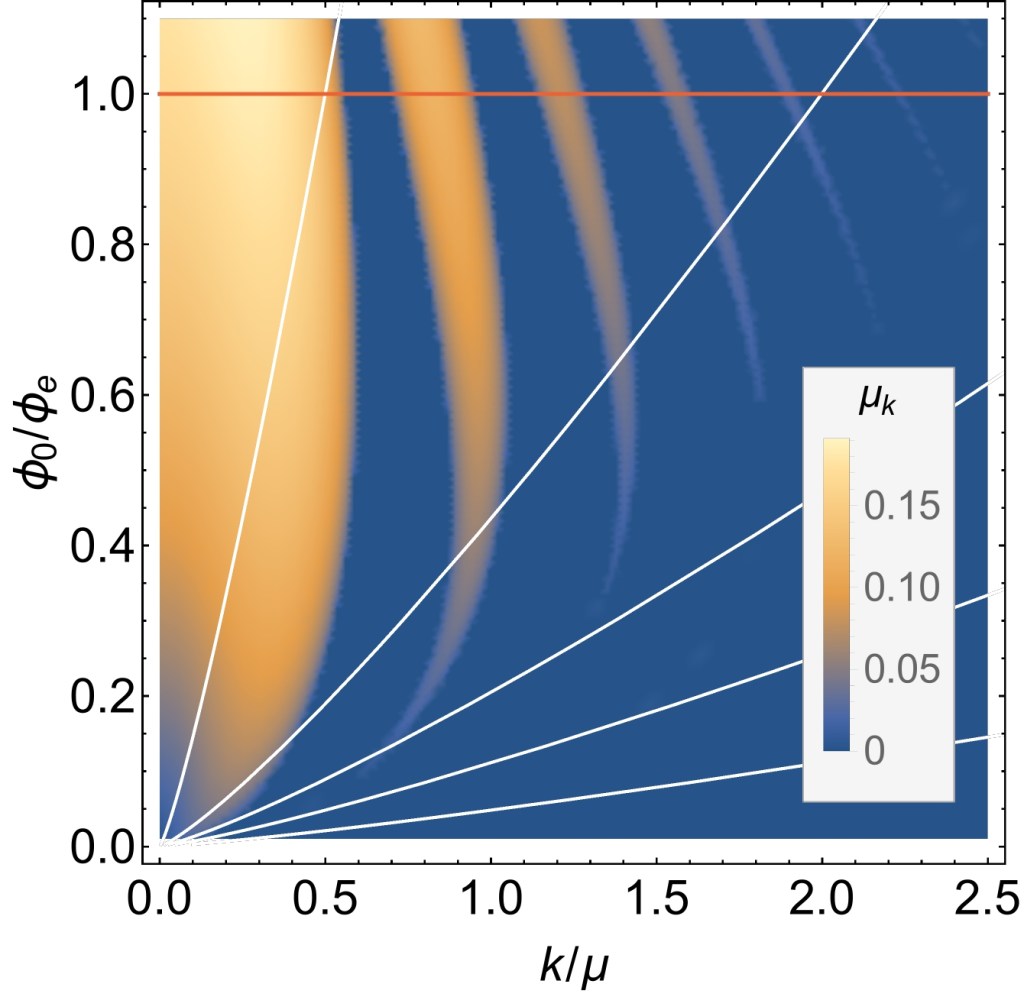
Related publications:
Universality and scaling in multi-field alpha-attractor preheating
O. Iarygina, E. I. Sfakianakis, D. G. Wang and A. Achucarro
JCAP 1906, 027 (2019)
Multi-field inflation and preheating in asymmetric alpha-attractors
O. Iarygina, E. I. Sfakianakis, D. G. Wang, A. Achucarro
arXiv:2005.00528
Codes
Studying the early Universe involves solving complex, non-linear dynamics that govern its evolution. To tackle these challenges, I use advanced numerical tools such as the Pencil Code and PyTransport, which allow us to simulate and understand the behavior of the Universe in its earliest moments.
 Oksana Iarygina